How to Build a Chicken Coop
By Shirley W. · September 16, 2026 · 15 min read
The short version. Check your ordinance before you buy a single board, because setbacks decide where the coop can stand and that changes the design. Size it by the largest number in the published range, not the smallest — the extension services disagree with each other by a factor of two, and the generous end is the one you will not regret. Ventilate high, above the birds' heads, and understand that moisture is what hurts them in winter, not cold. Use half-inch hardware cloth, not chicken wire, and bury an apron. And start from a real plan with a cut list, because the expensive mistakes in a coop build are mistakes of sequence, not of skill.
Disclosure: this post links to Easy Coops, a coop-plan library we're an affiliate for. If you buy a premium plan through our link we earn a commission. Their plans are free to browse and download, and we'd point you there regardless — every specification below is sourced from university extension services, not from them.
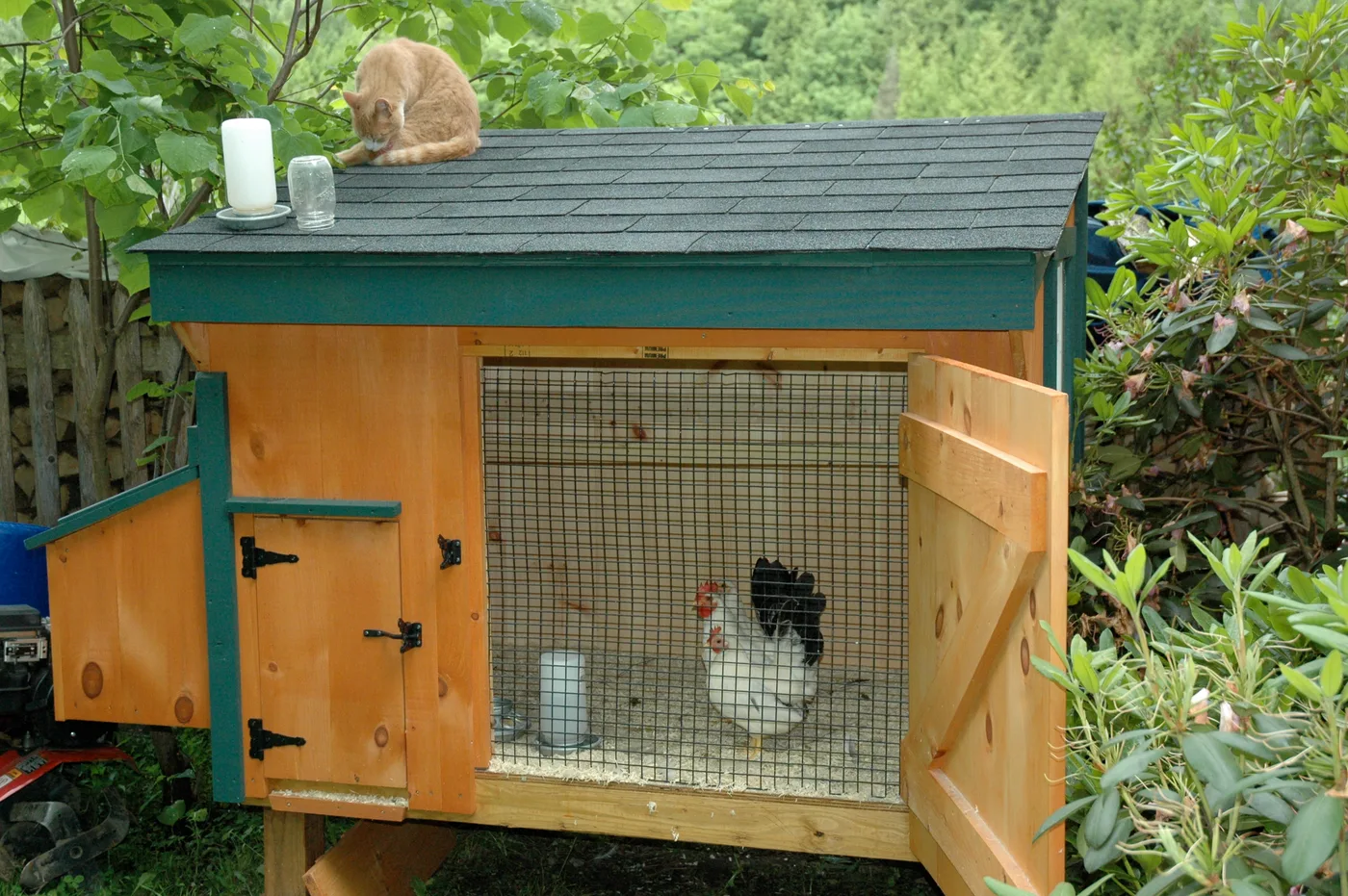
Most people build their first chicken coop twice. Not because the first one falls apart — it usually doesn't — but because it turns out to be too small, or too hard to clean, or the run is in the wrong place, or the door opens the wrong way and you spend two years squeezing past it with a full water jug.
This is a guide to getting those decisions right the first time. It is deliberately not one set of plans, because the right coop depends on your climate, your flock size and your lot. It's the set of numbers and constraints every good plan is built on, so you can read a plan critically instead of hopefully.
Jump to: What the law lets you build · How much space per chicken · Roosts and nest boxes · Ventilation · Predator-proofing · What it costs · Plans · The build order · FAQ
What do I need to check before building a chicken coop?
A coop is a structure, and structures are regulated. In most cities the binding constraints aren't about chickens at all — they're setback distances, accessory-structure size limits, and sometimes a permit threshold above a certain square footage.
The rules that will change your design:
- Setback from property lines and from neighbouring dwellings. Twenty-five feet from an adjacent house is common; some cities go to fifty. On a small lot this alone can decide the only legal spot.
- Maximum size of an accessory structure without a permit. Often 100 or 120 square feet. Cross it and you're in a permit process.
- Bird limits, and whether roosters are allowed at all, which sets the flock size you're designing around.
We wrote a full method for reading your own city's code in How to Check Whether You Can Legally Keep Chickens — including why you should search the code for fowl and poultry rather than chicken, and why roughly a third of the popular online answers we checked were wrong in a way that mattered.
Do this first. A coop that has to move three feet is a weekend of work; a coop that has to shrink is a rebuild.
How much space does a chicken need in a coop?
Here is something nobody selling you a coop will tell you: the published space recommendations are not settled science. The extension service that hosts the standard reference says so outright — "there is very little peer-reviewed research looking at the space allowances for backyard poultry" (eXtension, Space Allowances in Housing for Small and Backyard Poultry Flocks).
The result is that two reputable sources give numbers that differ by a factor of two:
| Penn State Extension | eXtension (poultry.extension.org) | |
|---|---|---|
| Indoor floor space, large chickens | 2 sq ft/bird | 3–4 sq ft/bird |
| Outdoor run | 10 sq ft/bird | 10 sq ft/hen |
| Bantams, indoor | 1 sq ft/bird | — |
Sources: Penn State Extension, Small Scale Poultry Housing; eXtension, Space Allowances.
Build to the top of the range. The failure mode of too little space isn't subtle — it's feather-picking, bullying, wet litter and the ammonia that comes with it. The failure mode of too much space is that you spent an extra forty dollars on plywood. For four large-breed hens, three square feet each puts you at twelve square feet of floor: a 4×4 coop with room to spare, or a 4×6 if you ever intend to add two more birds, which you will.
How many roosts and nest boxes do I need?
These numbers are far less contested than floor area. From Penn State Extension:
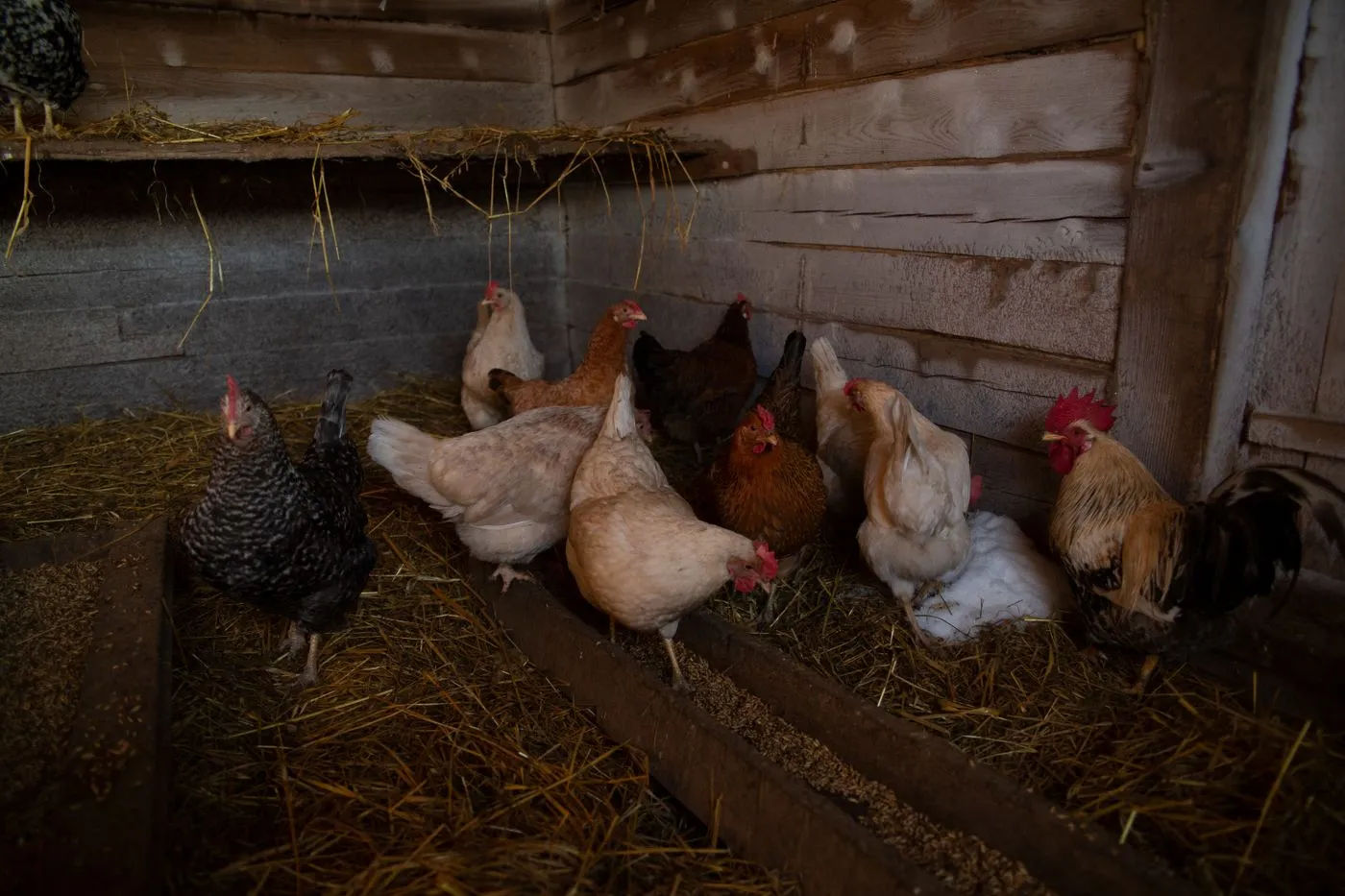
- Roosts: six inches of perch per standard bird, bars spaced one foot apart, 18–24 inches above the floor. Bantams take four inches each, 12–18 inches up. Never above four feet — birds injure their feet landing from height.
- Nest boxes: at least 12″ × 12″, two boxes for the first four hens and one more for every additional four. Mount them at least two feet off the ground and at least four feet away from the roosts.
- Feeder space: three inches per standard bird, three to four for large breeds. One water nipple per six to eight birds.
Two design consequences fall straight out of those numbers. Nest boxes sit lower than roosts, always — chickens sleep on the highest thing available, and if the boxes are highest they'll sleep in the boxes and foul the eggs. And roosts run perpendicular to the nest wall with real distance between them, which is why a 4×4 footprint gets tight faster than the floor-area math suggests.
How much ventilation does a chicken coop need?
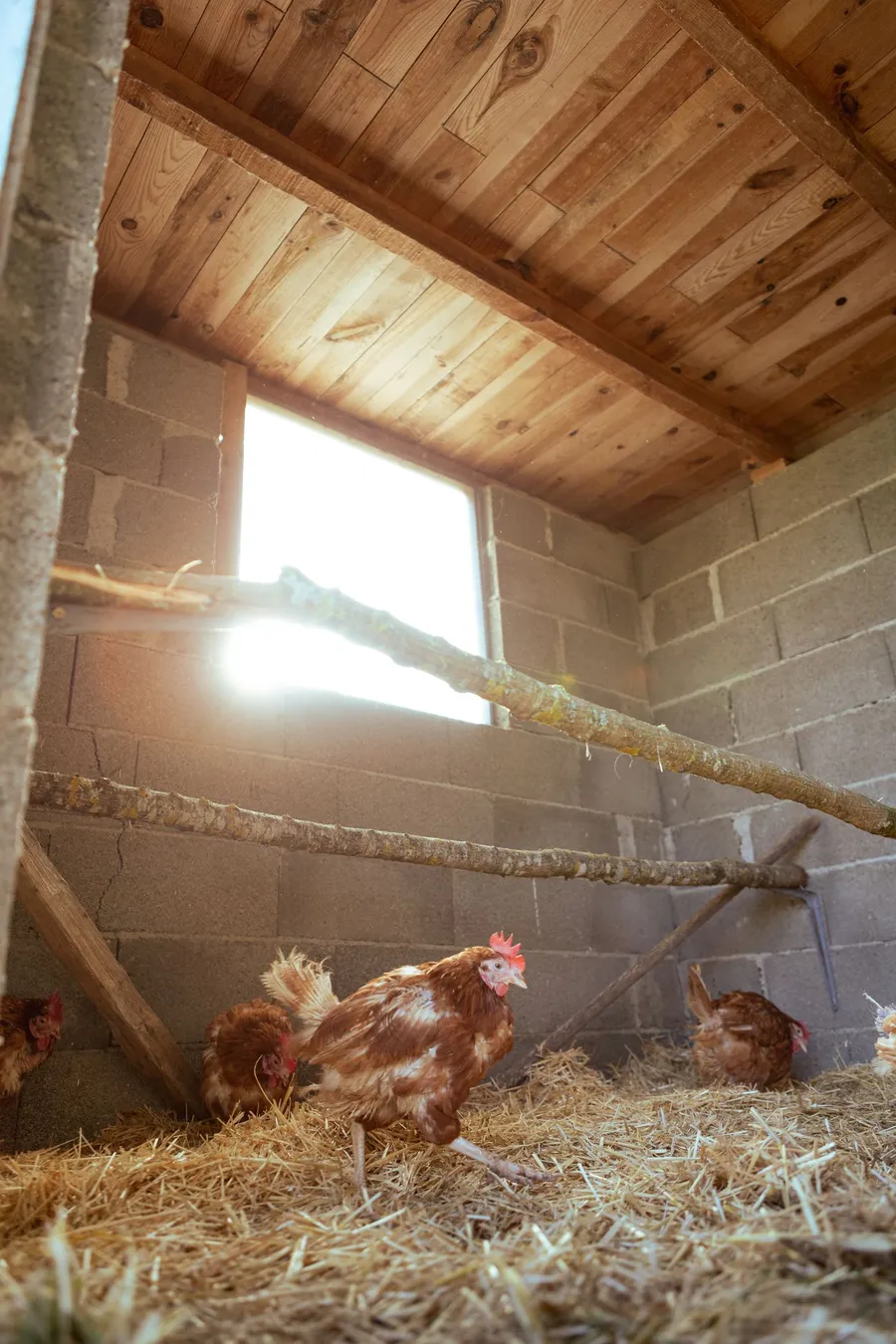
Ask how much ventilation a coop needs and you won't get a number. We went looking for one: the extension literature describes the mechanism — warm air rises, the chimney effect, exhaust above the birds — and declines to specify an opening area per bird or per square foot of floor (eXtension, Ventilation in Small and Backyard Poultry Flock Housing).
So here's the principle to design against, which matters more than a number would:
Cold doesn't hurt a healthy chicken. Moisture does. Frostbite in a backyard flock is a humidity problem that happens to occur at low temperature. As UMN Extension puts it, high moisture combined with cold leads to condensation, and condensation is what causes frostbite on combs and wattles. A sealed, "cosy" winter coop is the one that damages birds.
That gives you three rules:
- Vent high, above roost height. Warm, moist, ammonia-laden air rises off the birds and the litter, and it has to leave above their heads. Openings at bird level are drafts, not ventilation — the whole trick is air exchange without air moving across the birds.
- Put the openings on the side away from prevailing wind, and make them permanent. A vent you close in January is a vent that isn't there when you need it most.
- Trust your nose and your windows. If you smell ammonia when you open the door in the morning, or see condensation on the inside of the glass, you're under-ventilated right now — add opening or clean out litter, or both. That's the actual feedback loop, and it beats any formula.
Insulation is optional in most of the country. Draft-free is not, and ventilated is not.
How do I predator-proof a chicken coop?
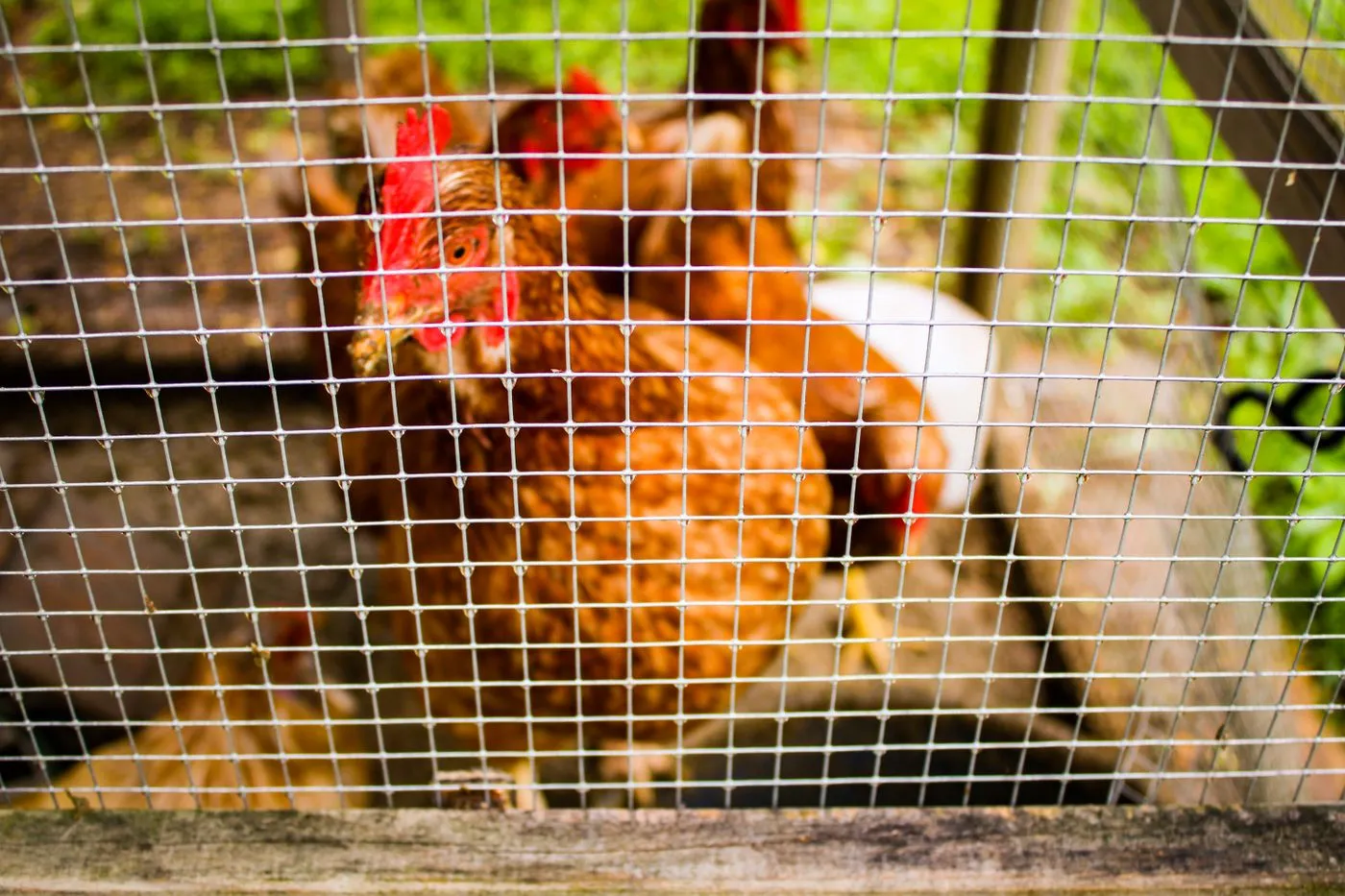
The single most common expensive mistake in a first coop is chicken wire. Chicken wire keeps chickens in. It does not keep anything out. A raccoon will reach straight through hexagonal poultry netting, and the result is grim enough that extension literature describes it plainly — raccoons "sometimes pull a bird's head through the wires of an enclosure."
What actually works:
- Half-inch galvanized hardware cloth over every opening — windows, vents, the pop door, the gap under the eaves. Not stapled: hardware cloth should be screwed through fender washers, because a determined raccoon pulls staples out of softwood.
- 1×2-inch welded wire or smaller for the run itself, rather than the cheaper 2×3 mesh, which CSU Extension notes results in greater bird loss where raccoons and mink are present.
- A buried apron. Penn State recommends burying the wire along the pen border at least 12 inches deep and toeing it outward about six inches, so a digging predator meets more wire the deeper it goes.
- Cover the run overhead where hawks or climbing predators are a concern — welded wire, netting, or even a criss-cross array of wires.
- Two-step latches on every door. Raccoons open simple hooks and slide bolts; they're genuinely good at it. A barrel bolt with a carabiner through it is a two-dollar fix.
The predator list is longer than most people expect: rats, skunks and snakes come from underneath, dogs and coyotes and bobcats clear a four-foot fence, and hawks and owls come from above at dawn and dusk.
How much does it cost to build a chicken coop in 2026?
Materials, not labour — and this is a year where that number moves under you. Framing lumber has been volatile through 2026 on the back of tariffs on Canadian imports, and plywood and OSB have swung considerably harder than dimensional lumber. Check the current figure yourself rather than trusting any guide's snapshot, this one included: NAHB publishes a framing lumber price index and Trading Economics tracks the futures.
Practically, that means sheet goods are the line item to watch on a coop build, because a coop is mostly sheathing and roof deck relative to its framing. It also means a cut list is worth real money right now: buying the right lengths, and getting four sides out of two sheets instead of three, is a bigger saving on a small build than it has ever been.
For scale, Easy Coops publishes estimated 2026 material costs alongside each design — roughly $675 for a 2×4 two-bird coop up to $8,250 for a 40×20, with a popular 6×6 nine-bird build estimated around $2,750. Treat those as the top of the range: they're retail pricing with a contingency built in, and most people building a small coop are using some reclaimed material.

(affiliate link)
Should I build a chicken coop from plans?
We want to be precise about what a plan is worth, because "buy plans" is easy advice to give badly.
A plan is not teaching you to cut a board. If you can build a bookshelf you can build a coop. What a plan gives you is the thing that's genuinely hard to recover from: order of operations, and a dimensioned cut list already reconciled against standard material sizes.
The mistakes that cost a weekend are all sequencing mistakes. Framing the nest-box wall before you decide which way the roof slopes. Sheathing the walls before you've cut the pop door, so now you're cutting it with a jigsaw through finished siding. Building the run before the coop and discovering the door swings into it. Sizing a wall at 49 inches, so every 4×8 sheet leaves an unusable offcut and you buy 30% more plywood than you need.
Easy Coops publishes 50+ designs with free downloadable PDF plans — materials lists, measurements and step-by-step instructions — with premium versions of each for more detail. The library is browsable by size and bird count, which is the right way to shop for a coop plan: start from the flock you intend to keep in three years, apply the floor-space number from the table above, and filter to plans at or above that footprint.
You can also take a free plan and modify it, which is what we'd suggest for anyone who already owns a saw. Use the cut list and the sequence; change the siding, the roof pitch, the door position. The value is in the parts that are tedious to work out, not the parts that are fun.
Browse the free coop plans at Easy Coops → (affiliate link)
What order do you build a chicken coop in?
Assuming a small raised coop with an attached run, this is the sequence that avoids the traps above:
- Site it. Legal setbacks first, then drainage — a coop on the low point of the yard is a wet coop forever. Then shade: afternoon shade matters more than morning sun in most of the country, because heat kills more backyard birds than cold does.
- Build the floor frame and level it on blocks or posts, raised at least 12 inches so the space underneath is shade the birds can use and not a rat harbourage.
- Frame the walls flat on the ground, with the openings — pop door, human door, windows, vents — cut into the framing now, before anything is sheathed.
- Stand the walls, then roof. Get it dry before you finish anything else.
- Interior: roosts, then nest boxes. In that order, because roost height determines nest-box height, not the other way round.
- Hardware cloth everything, screws and fender washers, on every opening.
- The run and the apron last, dug in 12 inches and toed outward six.
- Litter and a first clean-out test. Before the birds arrive, do one full mucking-out with the tools you actually own. If it's awkward now, it will be intolerable weekly.
That last step is the one nobody does and everybody wishes they had.
Four mistakes worth avoiding
- Building for the flock you're starting with. Almost everyone adds birds in year two. The marginal cost of two more feet of coop at build time is small; the cost of rebuilding is a whole weekend.
- A run you can't stand up in. A crouching-height run is one you'll stop maintaining. If the budget forces a choice, a smaller walk-in run beats a larger crawl-in one.
- Sealing it up for winter. Covered above, but it's the mistake that actually injures birds, so it's worth saying twice.
- Deep-cleaning design left for later. Decide where the muck goes, and how, on paper. A removable droppings board under the roosts is an hour of work and saves that hour every month.
Frequently asked questions
How big should a chicken coop be for 6 chickens? At the three-square-feet-per-bird end of the published range, 18 square feet of indoor floor — a 4×6 coop — plus about 60 square feet of run. Penn State's more conservative two square feet would let you build 4×4, but we'd size up: six birds is exactly the flock size that becomes eight.
Is it cheaper to build or buy a chicken coop? Building is cheaper per square foot and much cheaper per usable square foot, because flat-pack coops sold for "up to six hens" are routinely sized for three. Buying wins only on time. A plan closes most of the gap, since the expensive part of building is the mistakes, not the lumber.

(affiliate link)
Can I use chicken wire for a chicken coop? Only as a fence for keeping birds in an area you supervise. It is not a predator barrier — raccoons reach through it and dogs go straight past it. Every opening on the coop itself should be half-inch hardware cloth.
How high off the ground should a chicken coop be? At least 12 inches if it's raised, so the birds get shade underneath and rats get no harbourage. Roosts inside go 18–24 inches above the coop floor, and never higher than four feet.
Do chickens need a heater in winter? Almost never in the continental US, and a heat lamp in a wooden coop full of dry bedding is a genuine fire risk. Dry and draft-free beats warm. See the ventilation section above — moisture, not cold, is what causes frostbite.
Does a chicken coop need a floor? Not necessarily, but a raised coop needs one, and a floor makes cleaning out far easier. A dirt-floor walk-in shed style works well if you bury a hardware-cloth apron around the whole perimeter.

(affiliate link)
Then get the birds locally
A coop built to these numbers is worth filling with birds that arrive healthy. We're biased, but we'd rather you drove an hour than had day-olds shipped: the reasons are in Why Local Pickup Beats Shipping for Chicks and Birds.
If you haven't settled on breeds yet, Top 7 Beginner Chicken Breeds for 2026 covers the ones that tolerate a first-time keeper's mistakes, and Raising Backyard Chickens for Eggs covers what happens after the coop is finished.
When you're ready, ChickenMap lists live-poultry sellers and rescues by state and city, so you can see who is near you, what they have, and message them directly. And if you'd rather give a home to birds that already need one — including the roosters that so often need rehoming, covered in What to Do With a Rooster You Can't Keep — the rescues in the directory sit right alongside the sellers.
Coop photo by Putneypics, CC BY 2.0, via Wikimedia Commons — resized and converted to WebP. Other photos: Babydov, Misty Elchert and Andreas Ebner via Pexels.